Thursday, March 29, 2012

The Stock Market


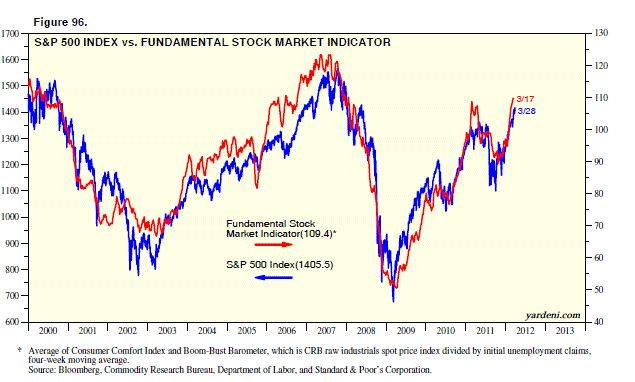
Our Fundamental Stock Market Indicator (FSMI) remains bullish. However, it did slip 0.2% during the week of March 17 after rising eight consecutive weeks by 15.9%. The next few weeks should be interesting for the three components of the FSMI:

(1) We’ll see if initial unemployment claims continues to fall. If it moves higher, then the weather-did-it crowd will jump for joy.

(2) The CRB raw industrials spot price index has been flattened in recent days on concerns that China’s economy is slowing and Europe is falling deeper into recession following the release of weak “flash” March PMIs last week. There will be another batch of global PMIs coming out for March early next week.

(3) The Weekly Consumer Comfort Index has been surprisingly buoyant in recent weeks despite rising gasoline prices.

Despite the surge in gasoline prices, consumer-related stocks have gone vertical this year. In the S&P 500, both Consumer Discretionary and Consumer Staples are trading at new record highs and at valuation premiums to the market. The Consumer Discretionary Retailing industry stock price index is up 20.1% ytd to a record high, and trading at about 18 times forward earnings.

BULLET POINTS FROM TODAY’S MORNING BRIEFING: (1) Next stop after 1400? (2) Will US lift global growth, or get dragged down? (3) The “weakness dividend” puts a lid on commodity prices. (4) Calming oil market’s jitters. (5) Go Home vs. Go Global. (6) Energy and Materials stocks diverging with commodity prices this year. (7) S&P 500 revenues still looking up. (8) Are durable goods orders durable? (9) Housing is crawling out of the cellar. (10) Do Industrials have more upside? (More for subscribers.)


Wednesday, March 28, 2012

Bernanke's Speech

Monday’s 1.6% increase followed a speech delivered in the morning by Fed Chairman Ben Bernanke before the National Association for Business Economics. It was a relatively technical discussion of recent developments in the labor market. The Fed Chairman concluded that while it is improving, there’s room for improvement. So Fed policy will remain accommodative, which was the main point I made in Monday’s Morning Briefing just before Bernanke confirmed my conclusion in his latest speech.

In his own words: “A wide range of indicators suggests that the job market has been improving, which is a welcome development indeed. Still, conditions remain far from normal, as shown, for example, by the high level of long-term unemployment and the fact that jobs and hours worked remain well below pre-crisis peaks, even without adjusting for growth in the labor force. Moreover, we cannot yet be sure that the recent pace of improvement in the labor market will be sustained.”

That is essentially the same message that FRBNY President Bill Dudley delivered in his speech on March 19 and that Professor Bernanke mentioned in passing during his GWU lecture on March 20. As I noted yesterday morning, the most important message for investors is that the Fed is in no rush to raise interest rates no matter how well the economy seems to be performing.

While the market was a bit wobbly last week, stock investors concluded on Monday that Mr. Bernanke is determined to lead them to Nirvana, where interest rates remain near zero even if the economy is growing robustly.

While there is some debate on whether the Fed Chairman implied in his speech that another round of quantitative easing is coming, I don’t think there was any ambiguity about his intention to keep the federal funds rate near zero even if the economy continues to improve. Here is what he said: “To the extent that this reversal has been completed, further significant improvements in the unemployment rate will likely require a more-rapid expansion of production and demand from consumers and businesses, a process that can be supported by continued accommodative policies. I also discussed long-term unemployment today, arguing that cyclical rather than structural factors are likely the primary source of its substantial increase during the recession. If this assessment is correct, then accommodative policies to support the economic recovery will help address this problem as well.”

The percentage of respondents agreeing that “jobs are hard to get” in the March Consumer Confidence survey rose to 41.0% from 38.6% in February. The jobs-hard-to-get response is highly correlated with the unemployment rate and suggests that the latter might not have continued to decline in March. We now have four regional business surveys for March covering the Fed districts around Dallas, New York City, Philadelphia, and Richmond. The average of the employment components of these four was little changed at last month’s most recent cyclical high.

BULLET POINTS FROM TODAY’S MORNING BRIEFING: (1) Sun-Tzu tells bulls to stay close to bears. (2) Blinder’s fiscal cliff. (3) Simpson-Bowles lite? (4) How lame will the lame ducks be? (5) Lots of popular loopholes. (6) Ryan’s Express on slow track unless Supremes kill ObamaCare. (7) When will stocks discount the cliff scenario? (8) Consumer stocks climbing every mountain. (9) Tech stocks still cheap. (10) The employment cliffhanger. (More for subscribers.)

Monday, March 26, 2012

The Bernanke Lectures


Back to school. In case you need a refresher course in central banking, Fed Chairman Ben Bernanke is providing a series of four free lectures on the Fed’s website. He delivered two of them last week at the George Washington University School of Business on Tuesday, March 20 and Thursday, March 22. There will be two more this week on Tuesday, March 27 and Thursday, March 29. The most important message for investors in the first lecture is that the Fed Chairman is in no rush to raise interest rates no matter how well the economy seems to be performing.

It’s great that the Fed Chairman has some free time to educate us. Of course, the point of this exercise is to let us know what an outstanding job the Fed has done in averting a financial meltdown during Bernanke’s watch. According to him, the Fed has done so well by learning from the mistakes made by monetary policymakers during the 1930s. No one has studied this subject more than he has. However, his intense focus on the role of monetary policy in causing and prolonging the Great Depression seems to have blinded him to other causes, such as the Smoot-Hawley Tariff, which isn’t mentioned even once in his Essays on the Great Depression (2000) or in his first lecture.

On November 8, 2002, when he was a Fed Governor, Ben Bernanke famously concluded the speech he gave at Milton Friedman’s 90th birthday as follows: “Let me end my talk by abusing slightly my status as an official representative of the Federal Reserve. I would like to say to Milton and Anna: Regarding the Great Depression. You’re right, we did it. We’re very sorry. But thanks to you, we won’t do it again.” The Great Depression was caused by monetary policy mistakes, and the Fed won’t make those mistakes again.

In his lecture, Mr. Bernanke blamed the Fed for causing the 1929 stock market crash by raising interest rates rather than focusing on “bank lending, on financial regulation, and on the functioning of the exchanges.” I would argue that the Fed set the stage for the latest financial crisis by raising interest rates too slowly in the years before the crisis. Presumably that was meant to avoid repeating the bad economic “side effects” that rising rates had in the 1930s, according to the first lecture. The lesson learned during the 1930s made the Fed too cautious this time. Worse, in the years preceding the latest financial crisis, the Fed failed to regulate the excesses in the over-the-counter exchanges for credit derivatives. That led to the collapse of securitization, which triggered a credit crunch that nearly caused another Great Depression.

In his lecture, the Fed Chairman observed that the Great Depression was actually two recessions with a severe downturn from 1929-1933 and another one in 1937-1938. In between the two, there was a good recovery. While he concedes that the cause of the second downturn is controversial, he believes it was a “premature tightening of monetary and fiscal policy.” He concluded: “I think if you accept that traditional interpretation…you need to be attentive to where the economy is, and not move too quickly to reverse the policies that are helping the recovery.”

Today’s Morning Briefing Bullet Points: (1) Paradise found. (2) An impressive 6-month bull market within an impressive 3-year bull market. (3) Bernanke bad-mouths good employment indicators. Stocks cheer. (4) Leaders are Consumer Discretionary, Financials, & IT. (5) Revenue estimates continue to rise. (6) P/E-led rally has more upside. (7) PEG ratios find value in Consumer Discretionary, Industrials, and IT. Overvalued are Consumer Staples, Health Care, Telecom, and Utilities. (8) Housing recovery stalled in Feb. and Mar. (9) Another happy employment indicator in Texas. (10) Still some oomph in Germany’s Ifo. (More for subscribers.)


Global Industrial Production

Despite all the natural and man-made disasters of 2011, global industrial production rose to a record high during the final month of last year based on an index compiled by the OECD for its 30 members of “advanced” economies and the six largest emerging economies. That index now exceeds the previous cyclical high during January 2008 by 3.8%. On the other hand, the index for just the 30 members was flat most of last year and remains 5.5% below its January 2008 cyclical (and record) peak. The resilience of the global economy in the face of the huge hit to Japanese manufacturing caused by the earthquake in March and the financial crisis in Europe is impressive.

Among the OECD economies, weakness in European production indexes has been offset by strength in the US. The Euro Zone 17 index of industrial production is down 3.5% over the past five months through January. Over the same period through January, the US manufacturing output index is up 3.4%. The latter did slow to a gain of 0.3% during February following 1.1% during January, which was revised upwards from 0.7%. Over the past three months through February, US manufacturing rose at an annualized rate of 9.6%, based on its three-month average.

TODAY’S MORNING BRIEFING BULLET POINTS: (1) Professor Bernanke explains it all. (2) Lessons learned from the 1930s. (3) Making new mistakes. (4) ZIRP no matter what. (5) Fizzle fears for a third year. (6) Two of the stool’s three legs are wobbling. (7) Spain’s pain. (8) A power struggle in China? (9) Spring break or spring wobble? (10) Underweighting Europe. (11) The global economy is slowing, not stalling. (More for subscribers.)

Thursday, March 22, 2012

S&P 500 Revenues & Earnings

What do industry analysts know that we don’t know? They know more about the companies they follow than the rest of us who have chosen different career paths in the investment business. When I analyze the earnings, revenues, and profit margins of the S&P 500 along with its sectors and industries, I start by taking a peek at the data compiled weekly by Thomson Reuters on the analysts’ consensus for these variables. Then I try to reconcile my top-down “macro” model of these variables with the bottom-up “micro” expectations of the analysts.

What I am beginning to see recently is that industry analysts are turning more optimistic about the prospects for revenues this year and next year. They have also recently stopped lowering their earnings estimates for both years after having done so nearly every week since mid-2011.

Industry analysts have been nudging up their 2012 consensus estimate for S&P 500 revenues and raising their 2013 estimate since last fall, after lowering their expectations last summer. They expect that revenues will increase 4.5% this year and 5.5% next year. I track the time-weighted average of these annual estimates, which is a proxy for 52-week forward expected revenues. This measure bottomed at $910 during the week of September 24, 2009 and rose 22% to $1,110 during March 15 of this year. Along the way, there were soft patches during the second half of 2010 and last summer. But now, forward revenues for the S&P 500 is at a cyclical high and only 2.4% below the previous record high in mid-2008. (More for subscribers.)