
Saturday, September 29, 2012

Thursday, September 27, 2012
Valuation
 |
So what is the correct P/E for the S&P 500? Our “Blue Angels” analysis of earnings momentum and valuation shows that 13 has been an unlucky number for the P/E for the past three years. The rallies of 2010 and 2011 were followed by nasty corrections after the P/E rose to 13. On September 14, the P/E was back just above this jinxed level. Now it is just a bit below it.
Then again, I’m hearing more folks in our business talking about the “Rule of 20.” Stocks are deemed to be cheap (expensive) when the sum of the P/E and the CPI inflation rate is below (above) 20. The CPI was up 1.7% y/y during August. Using the S&P 500’s forward P/E, the sum of the two was only 14.4 during August, suggesting plenty of upside for the valuation multiple. In my opinion, while the Rule seems to work at extremes, it isn’t a sure way to determine where the P/E is heading next most of the time. I suppose that the actual implementation of open-ended quantitative easing by both the Fed and the ECB could lift the P/E above 13 to 14 by the end of the year. If forward earnings rises from 112 now to 115--equaling the current consensus forecast for next year (assuming that doesn’t change)--then the S&P 500 has the potential to rise to 1610 by the end of the year. I think that’s not likely to happen until we see how the US elections play out. That will influence how Washington deals with the fiscal cliff, which will certainly result in a US recession early next year if Congress remains gridlocked. In addition, mounting social unrest in China and Europe are also weighing on the outlook for global economic growth next year. Oh, and then there is all the commotion in the Middle East. These uncertainties are likely to keep a lid on valuation for a while. Today's Morning Briefing: Social Unrest & Valuation. (1) Plosser is skeptical about QE3. (2) Caterpillar is cautious about the global economy. (3) Remarkable resilience in earnings expectations. (4) The number 13 has been unlucky for P/E over the past couple of years. (5) The case for 14. (6) The case against the “Rule of 20.” (7) Lots of headlines about social unrest in China and Europe. (8) What’s the impact on valuation? (More for subscribers.) |

Tuesday, September 25, 2012
Wicked
 |
Something Wicked This Way Comes is a 1962 novel by Ray Bradbury. It’s about two Midwestern 13-year-old boys, who have a nightmarish experience with a creepy traveling carnival that comes to their town in October. This is a month that has sometimes been a very scary one for stock investors too. But it has also been a good month for them on numerous occasions. The month ends with Halloween, the trick-or-treat holiday.
If something wicked this way comes in October, it is most likely to be a war in the Persian Gulf. The next two full moons over Iran will be September 30 and October 29. Israeli drones will have more light at night to assess the damage done to Iran’s nuclear facilities. Of course, another possible scenario is that Iran’s wicked President Mahmoud Ahmadinejad will once again deliver a vile speech before the UN General Assembly in NYC on Wednesday (on Yom Kippur!), and the only response will be that some delegates walk out of the carnival, as they did last year when he called the 9/11 attacks "mysterious."
Iran's lunatic already started to rant and rave yesterday, according to a story in Reuters that might very well convince the Israelis to go to war. UN Secretary-General Ban Ki-moon met Ahmadinejad on Sunday and warned him of the dangers of incendiary rhetoric in the Middle East. Meeting with reporters yesterday, Iran’s provocateur said: "Iran has been around for the last seven, 10 thousand years. They [the Israelis] have been occupying those territories for the last 60 to 70 years, with the support and force of the Westerners. They have no roots there in history," referring to the founding of the modern state of Israel in 1948. He added, "We don't even count them as any part of any equation for Iran. During a historical phase, they [the Israelis] represent minimal disturbances that come into the picture and are then eliminated." Let’s see if he can top that act tomorrow in his speech before one of the creepiest carnivals on earth.
If war is coming to the Persian Gulf, why has the price of a barrel of Brent crude oil plunged by $6.79 from a recent peak of $117.19 on September 14 to $110.40 this morning? As I noted last week, the global crude oil demand-to-supply ratio is actually quite bearish. However, all the latest saber rattling between Israel and Iran should be adding a war premium to the price of oil.
Despite the recent weakness in the price, large speculators are once again holding near-record net long positions in both crude oil and gasoline. Maybe they know something. Or else, that could be a good signal for contrarians to short oil, especially if they figure that a war isn’t likely. Alternatively, if a war happens, it would cause a temporary spike in the price of oil that would send the global economy back into a recession and oil prices much lower. What will the central banks' carnival clowns do for an encore in that event?
Today's Morning Briefing: Wicked. (1) The carnival is back in town. (2) Trick or treat? (3) October is a typical month, but with more crashes. (4) Fed and ECB punish risk-averse investors. (5) Next full moon over Iran. (6) Wicked Wednesday at UN carnival. (7) The Mad Man’s speech. (8) Why are crude oil prices falling? (9) Won’t be surprising if Q3 earnings are disappointing. (10) Not much deleveraging in the Fed's latest flow of funds report. (More for subscribers.)
|

Monday, September 24, 2012
NZIRP Forever

 |
Why can’t they all get along and leave well enough alone? The members of the Federal Open Mouth Committee (FOMC) are already yapping away about what they should or should not do after implementing “QE3 Forever” less than two weeks ago on September 13. A few are already pushing for “NZIRP Forever.” (NZIRP = near-zero interest rate policy.)
On September 20, FRB Minneapolis President Narayana Kocherlakota said the Fed should target the federal funds near zero until unemployment falls below 5.5% as long as inflation doesn’t exceed 2.25%. Previously, he tended to side with the FOMC’s hawks. Now he is even more liberal than FRB Chicago President Charles Evans, a super-dove who has been advocating NZIRP until the jobless rate falls below 7%. Evans can declare victory since that seems to be the new policy implied in the 9/13 FOMC statement, though Fed Chairman Bernanke denied during his 9/13 press conference that there is a specific unemployment rate that is being targeted. FRB Dallas President Richard Fisher, an outspoken critic of the Fed’s unconventional monetary policy easing programs, is not a voting member of the FOMC this year. However, he undoubtedly lashed out at QE3 Forever during the latest meeting of the Fed’s policy-setting committee. He shared his dissident's views with the public on last Wednesday, September 19, in a speech before the Harvard Club of NYC. His most sarcastic punch line: “We are blessed at the Fed with sophisticated econometric models and superb analysts. … The truth, however, is that nobody on the committee, nor on our staffs at the Board of Governors and the 12 Banks, really knows what is holding back the economy. Nobody really knows what will work to get the economy back on course.” It was a not-too-subtle dig at Fed Chairman Ben Bernanke’s recent Jackson Hole speech, in which he claimed that the Fed’s econometric models confirmed that the Fed’s previous unconventional policy measures had worked to boost economic growth and lower the unemployment rate, though the jobless situation remained “grave” by his own admission. Fisher went on to observe that small and medium-sized businesses, “the wellsprings of job creation,” are hesitant to expand their payrolls at a more normal faster pace because of regulatory and fiscal uncertainty, not tight credit. Big business, which accounts for much of capital spending, is also stymied by the same concerns and is using NZIRP as an opportunity to borrow cheaply in the bond market to buy back stock rather than to expand. The positive wealth effect on stocks is more than offset by the weakness in capital spending, in Fisher’s opinion. I agree. Movie. “Trouble with the Curve" (+) (link) stars Clint Eastwood as an aging baseball scout for the Atlanta Braves. He doesn’t talk to any empty chairs, though he is losing his eyesight in the movie. But at the same time, he is finding out how to get closer to his daughter, whom he neglected when she was growing up. One of the messages of the film is that computer models can’t beat common sense. I hope Ben Bernanke goes to see the film and gets this point. Today's Morning Briefing: Leading & Misleading Indicators: (1) Fed chatter never ends. (2) Fisher vs. Bernanke, Evans, and Kocherlakota. (3) Despite high-powered models, Fed is clueless. (4) A shortage of money isn’t the problem for employers. (5) ECRI: There they go again seeing a recession. (6) False alarms and top secrets. (7) Composite indicators can go rogue. (8) Our own formula is no secret. (9) Bad geopolitical vibes and bad global economic indicators. (10) The case for sector neutrality. (11) “Trouble with the Curve” (+). (More for subscribers.) |
Saturday, September 22, 2012
QE3: A Brief History
 |
It was only a week ago that the Fed's FOMC formally implemented its latest and most radical version of quantitative easing on September 13. While the details surprised the markets, the concept of an open-ended QE3 was first floated by John Williams, president of the Federal Reserve Bank of San Francisco, in a July 23 interview in the FT. He is a voting member of the FOMC.
In the interview, Williams warned of significant downside risks to the US economy from the fiscal cliff, the euro zone crisis, and the global slowdown. He favored QE3 with the Fed buying mortgage-backed securities. He proposed that it be open-ended without specifying how much the Fed would purchase and when the program would end. That’s exactly what the Fed implemented last week. (I highlighted this story in our Morning Briefing the very same day it appeared in the FT.)
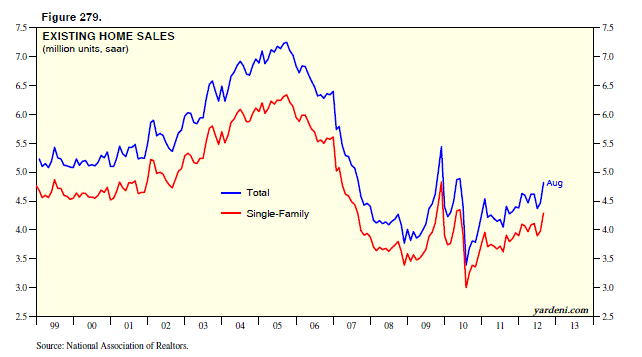
Williams floated the idea again in an interview reported in the 8/10 issue of the San Francisco Chronicle. When he was asked whether QE3 should be saved to cushion the fall off the cliff early next year, if necessary, he responded: "We want to position the economy to be strong in advance of that. If you are really worried about running out of ammunition, you want to act more aggressively, more quickly and better prepare yourself for that eventuality." (I believe the question was inspired by a conversation I had with the reporter who asked me what I would ask Mr. Williams.) Boston Fed President Eric Rosengren, who is a non-voting member of the FOMC, seconded Williams’ motion for open-ended QE3 in an interview reported in the 8/7 WSJ. According to the minutes of the July 31-August 1 FOMC meeting, released yesterday, "Many participants expected that such a [QE] program could provide additional support for the economic recovery both by putting downward pressure on longer-term interest rates and by contributing to easier financial conditions more broadly." On August 23, I made the following prediction about Fed Chairman Ben Bernanke’s next big speech: “I think there’s a chance that he might announce during his August 31 speech at Jackson Hole that the Fed will launch an open-ended QE3 program with the hope of turbocharging the economy so that it can leap over the cliff.” He didn’t do so explicitly, but he certainly set the stage for the FOMC decision on September 13 by expressing his “grave concern” about the unemployment problem. For quite some time, I’ve sided with the FOMC’s hawks, who have been critical of QE. I wasn’t a fan of QE2. I think it backfired, reducing the purchasing power of consumers by boosting food and fuel prices. I wasn’t rooting for QE3. There are lots of other critics of the Fed's latest unconventional easing program. However, now that it’s a done deal, I’m willing to be open-minded about open-ended QE3. As I previously noted, Bernanke & Co. were very clever to focus QE3 on purchasing mortgage-backed securities since the housing market was starting to recover without any additional assistance from the Fed. If it continues to do so, they can take credit for it! Sure enough, the latest data for new and existing home sales and for housing starts all look quite good. The most current series, available for September, are based on a monthly survey of members of the National Association of Home Builders. Their overall Housing Market Index rose this month to 40, up from 14 a year ago and the best reading since June 2006. August was a very good month for existing home sales, which jumped 7.8% m/m. If QE3 boosts US economic growth by giving the housing industry an extra lift, that would be good for earnings. If it weakens the dollar, that would be good for earnings. The JP Morgan trade-weighted dollar index was up as much as 9.3% y/y this year on July 24. It is now flat y/y. As a very rough rule of thumb for the S&P 500, I reckon that a 10% increase in the dollar will depress profits from overseas by 20% and total profits by 10%. |
Subscribe to:
Posts (Atom)