 |
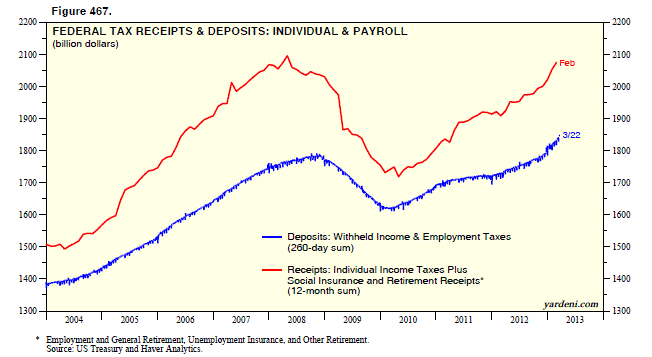
The next big positive surprise in the US economy is likely to be that federal tax receipts are increasing faster than expected. That would certainly help to improve the budget deficit outlook and might make it easier to achieve at least some modest bipartisan agreements to lower the structural deficit and to reform the tax system.
I monitor the Treasury's daily data on federal tax receipts and deposits for individual and payroll taxes as well as for corporate income taxes. The daily data obviously are very volatile so I smooth them out with 260-day moving sums, which closely track the Treasury’s monthly data on a 12-month sum basis. The Treasury’s deposits of withheld income and employment taxes rose to a new record high on March 22. Corporate income tax receipts are the highest since February 2009. Today's Morning Briefing: Decoupled. (1) The end has been postponed. (2) The moments after the Cyprus Moment. (3) Mr. Dijsselbloem's little fiasco. (4) Draghi to the rescue again. (5) Scrounging for good news in Europe. (6) More happy indicators in the US. (7) PMI down in Europe, up in US. (8) Houses are selling lickety-split. (9) Federal tax revenues are on the rise. (10) Earnings are still breaking records. (More for subscribers.)  |

Monday, March 25, 2013
US Treasury Tax Receipts (Excerpt)

Sunday, March 24, 2013
US Petroleum (Excerpt)
 |
Leading the recent strength in the US economy is the long-delayed rebound in the housing industry.The Energy Revolution is also boosting economic activity. US crude oil production has soared by nearly 1.0 mbd over the past 27 weeks through mid-March. I am now tracking weekly production data by states, especially Texas (which is up 0.9 mbd over the past 52 weeks) and North Dakota (up 0.3 mbd).
US exports of petroleum products rose to a new record high of 3.2 mbd in mid-March. Those exports will most likely continue to increase as more domestically produced oil flows down to refineries along the Gulf of Mexico. As a result, US net imports of crude oil and petroleum products, currently at 6.7 mbd, should continue to decline, as they have been since peaking at a record 13.6 mbd during November 2005. In recent meetings with some of our accounts, I’ve detected some skepticism about the Energy Independence theme touted by the secular bulls, including yours truly. The skeptics note that old wells don’t end well. In other words, fracking them yields more oil for a very short time before they are depleted. That’s why I am starting to monitor weekly oil production data by state. Today's Morning Briefing: Crisis Champ. (1) Oscar for best crisis management. (2) Worst crisis managers. (3) Panics have been buying opportunities. (4) The mouse that roared. (5) US leading indicators are looking up. (6) Gushing over gushing oil. (7) Monitoring depletion. (8) Making nice in DC and Jerusalem. (9) China reforming again. (10) Time out for Little Kim. (11) Performance Derby turned defensive last week. (12) Risk On again post-Cyprus? (More for subscribers.)  |
Wednesday, March 20, 2013
The Fed & Inflation (Excerpt)
 |
In the US, the underlying trend in the CPI inflation rate tends to be driven by labor costs, which reflect wages (boosting inflation) and productivity (reducing inflation). There is a good correlation between core CPI inflation on a y/y basis and wage inflation. There is also a strong inverse correlation between the unemployment rate and wage inflation. The Fed’s working assumption seems to be that wage inflation won’t heat up as the unemployment rate falls. If that assumption is wrong, inflation may not stay as “well anchored” as the FOMC expects, forcing the committee to raise the federal funds rate well before the jobless rate falls to 6.5%.
Today's Morning Briefing: The Fed's Holy Grail. (1) The Fed’s mantra: 6.5% or bust! (2) From date-based to data-based guidance. (3) Esther George may not be lonely for long. (4) Phasing out QE as the quid pro quo for NZIRP. (5) All will be well as long as financial imbalances can be managed. (6) But what if price inflation makes a comeback? (7) There’s still an inverse relationship between jobless rate and wage inflation. (More for subscribers.)  |
Tuesday, March 19, 2013
Stock Market Indicators (Excerpt)
 |
The S&P 500 is highly correlated with the inverse of the four-week moving average of initial unemployment claims, which dropped to 346,750 during the week of March 9. That’s the lowest reading since March 2008. The S&P 500 is even more highly correlated with our Fundamental Stock Market Indicator (FSMI), which includes jobless claims. Our FSMI also includes the Bloomberg Consumer Comfort Index and the CRB raw industrials spot price index. It is up by 6.7% over the past nine weeks to the highest reading since November 2007.
Today's Morning Briefing: On the Margin. (1) Will depositors get toasted in Cyprus? (2) Don’t mess with Putin’s stash. (3) A deal will be done. (4) Aging bull still has legs. (5) Bullish: Jobless claims lowest since March 2008. (6) Our FSMI supports the bull. (7) Housing is following our “Second Recovery” script. (8) CoreLogic reports fewer underwater homes. (9) Forward earnings at new highs again. (10) S&P 500 margin in holding pattern. (11) Global oil demand at new high. (12) Non-OPEC supplies at new high too. (More for subscribers.)  |
Monday, March 18, 2013
Euro Mess (Excerpt)
 |
The latest mess in the Euro Mess is a reminder that Mario Draghi's pledge to do whatever it takes to defend the euro won't clean up the mess. The pledge bought time, which must not be wasted or the Euro Mess will last for years to come. The “Cyprus Moment” is yet another waste of time.
For now, the euro zone is falling deeper into recession, as evidenced by the region's weak production numbers during January. The UK is heading in the same direction. The question is how long will the Cyprus Moment last, and will it morph into Europe's Lehman Moment? I doubt it. So far, government bond yields for both Italy and Spain remain subdued. Today's Morning Briefing: Safe Haven. (1) Upside to Europe's downside. (2) Can risk be on in US, but off elsewhere? (3) Fewer safe havens for laundering money. (4) How long will the Cyprus Moment last? (5) The dollar is a safe haven again. (6) European investors are buying US stocks. (7) A shortage of stocks as a result of buybacks & M&A. (8) Only 3,678 companies in Wilshire 5000! (9) US and OECD inflation rates remain subdued. (More for subscribers.)  |
Subscribe to:
Posts (Atom)